A Demonstrably Valid Cipher:
Hypnerotomachia Poliphili, 1499
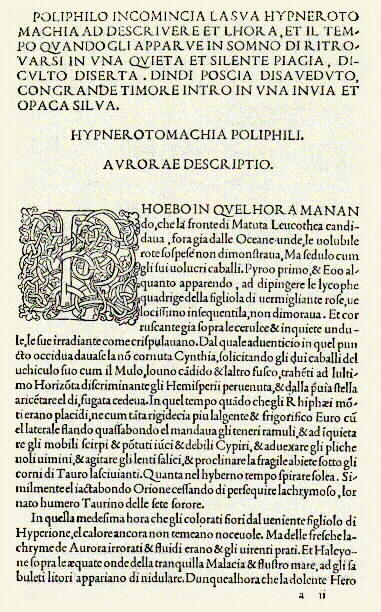

P |

O |

L |

I |

A |

M |

F |

R |

A |

T |

E |

R |

F |

R |

A |

N |

C |

I |

S |

C |

V |

S |

C |

O |

L |

U |

M |

N |

A |

P |

E |

R |

A |

M |

A |

V |

I |

T |
POLIAMFRATERFRANCISCVSCOLVMNAPERAMAVIT
POLIAM FRATER FRANCISCVS COLVMNA PERAMAVIT
Brother Francisco Colonna madly loved Polia.
Demonstration of Validity, after the Friedmans' methods
- the plain-text solution must make sense, in whatever language it is supposed to have been written
- it must be grammatical ('Hearts green slow mud' would not do) and
- it must mean something ('Pain is a brown Sunday' would not do either).
- It does not matter whether what the solution says is true or not; it may be a pack of lies, but that is not the cryptologist's business.
- the cipher system and the specific key also have to obey certain rules. The specific keys may be few or many, simple or complicated, but
- they must be unambiguous
- once the rules are known, it must be possible to apply them precisely and inflexibly
General rule: the cipher is an acrostic
Specific key: take the display capital letters of each chapter in order.
What are the odds against this solution's being an accident?
Use the Vulgate Bible as a representative sample text
- Of the 648,974 words in the Vulgate, 37,664
(or about 8.2%) begin with the letter "P." Assuming that the Vulgate is a
reasonable sample, we could say there is about a 1 in 17 chance that the
first display capital would be a "P."
- There is about a 1
in 41 chance that the second letter would be an "O";
- 1 in 60 chance that
the third letter would be an "L";
- 1 in 10 chance that the fourth letter
would be an "I";
- 1 in 12 chance that the fifth letter would be an "A";
and
- 1 in 19 chance that the sixth letter would be an "M."
There is then
about 1 chance in (17*41*60*10*10*12*19) or 1 in 100,422,924 that the
first 6 display letters would be "POLIAM."
If we go through the entire
set of display capitals at the beginnings of the chapters, we find that
there is about 1 chance in
10,100,128,459,604,200,000,000,000,000,000,000,000,000,000,000,000 that
the display capitals would be in this order: "POLIAMFRATERFRANCISCVSCOLVMNAPERAMAVIT."
1 in 10,100,128,459,604,200,000,000,000,000,000,000,000,000,000,000,000