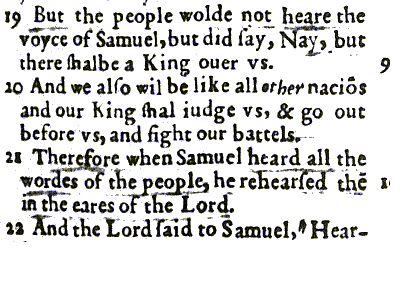
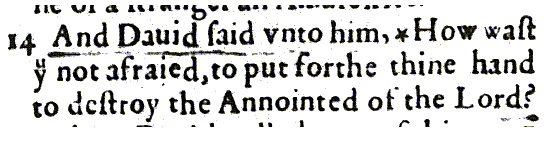
14 And David said unto him, How wast yu not afraied, to put for the thine hand to destroy the Annointed of the Lord? [506]Oxford's Bible; see also Stritmatter's image on [103|66].
Kathman correctly transcribes the annotation:
Cropped marginal note in GB reads "Oxen 22000/Shepe 122000" The number of sheep is in error, adding an extra 2000 to the texts's figure of 12000.
oxen - 22000
shepe 1220000
A more accurate comparison: both Kathman's and Stritmatter's accounts are generally reliable when the two accounts agree; in most instances where they disagree, Kathman seems to be more reliable.
Stritmatter mentions Kathman several times, sometimes characterizing his work harshly. Kathman's list was compiled without reference to Stritmatter's list; Kathman's list was published online in 1998, two years before Stritmatter's dissertation was defended, and three years before it was printed.
 Ecclesiasticus 14.13 reads, "Do good vnto thy friend
before thou dye, and according to thine habilitie stretche out thine hand, and giue him."
An annotator crossed out "him" in OxBib and wrote "vnto the poore". Stritmatter thinks
the change is a translation by an annotator of the Vulgate "da pauperi." Tom Veal suggests
that the changed text reflects the Douay reading "to the poor"; since the Douay edition was not
printed until several years after Oxford
died, this would be prima facie evidence that Oxford could not have made this annotation.
Much more likely than either Stritmatter's or Veal's scenario is that an annotator
was refering to Miles Coverdale's translation of Ecclesiaticus, which appeared in numerous
earlier English Bibles, including Coverdale's, Matthew's, the Great Bible, and the
Bishops' Bible, as well as in Coverdale's Bokes of Salomon. Here, for comparison,
are versions found in the Vulgate, Coverdale, Matthew's, Bishops', Geneva, Douay, and King James
Ecclesiasticus 14.13 reads, "Do good vnto thy friend
before thou dye, and according to thine habilitie stretche out thine hand, and giue him."
An annotator crossed out "him" in OxBib and wrote "vnto the poore". Stritmatter thinks
the change is a translation by an annotator of the Vulgate "da pauperi." Tom Veal suggests
that the changed text reflects the Douay reading "to the poor"; since the Douay edition was not
printed until several years after Oxford
died, this would be prima facie evidence that Oxford could not have made this annotation.
Much more likely than either Stritmatter's or Veal's scenario is that an annotator
was refering to Miles Coverdale's translation of Ecclesiaticus, which appeared in numerous
earlier English Bibles, including Coverdale's, Matthew's, the Great Bible, and the
Bishops' Bible, as well as in Coverdale's Bokes of Salomon. Here, for comparison,
are versions found in the Vulgate, Coverdale, Matthew's, Bishops', Geneva, Douay, and King James
| Vulgate | ante mortem benefac amico tuo et secundum vires tuas exporrigens da pauperi | ||
|---|---|---|---|
| Coverdale | Do good vnto yi frende before thou dye, and acordinge to thy abylite reach out thine hande, and geue vnto ye poore. | ||
| Matthew's | Do good vnto thy frynde before thou dye, & according to thy abilitie reache out thyne hande, & geue vnto the poore. | ||
| Bishops' | Do good vnto thy friende before thou dye, and according to thy abilitie reache out thyne hande & geue vnto the poore. | ||
| Geneva | Do good vnto thy friend before thou dye, & according to thine habilitie stretch out thine hand, and give him. | ||
| Douay | Do good to thy friend before thou die, and according to thy ability, stretching out thy hand give to the poor.
| King James | Do good unto thy friend before thou die, and according to thy ability stretch out thy hand and give to him. |
|